Japanese Names for Things & Places offer a lovely way to explore Japanese language, culture, landscapes, everyday objects, and familiar locations. Japanese words often carry a sense of nature, beauty, simplicity, and tradition, making them useful for creative writing, character naming, games, art projects, usernames, and themed collections.
This guide brings together Japanese words for natural features, celestial objects, water and landscapes, buildings, household items, everyday objects, food, and travel destinations. Each entry includes kanji where commonly used, an English meaning, and a simple description to help you understand its use.
How to choose a suitable Japanese word

When choosing from Japanese Names for Things & Places, consider both the sound of the word and its meaning. Some words are ordinary nouns rather than personal names, while others can also work as creative names for fictional locations, projects, or characters.
Japanese writing can vary according to context, and some words are usually written in hiragana or katakana instead of kanji.Think about the feeling you want the word to express, whether it is peaceful, powerful, elegant, or playful.
Check the pronunciation and cultural meaning to ensure the word suits your intended purpose. If you plan to use the word publicly, choose a spelling that is easy to read and remains faithful to its original Japanese meaning.
Japanese Names for Nature and Natural Things
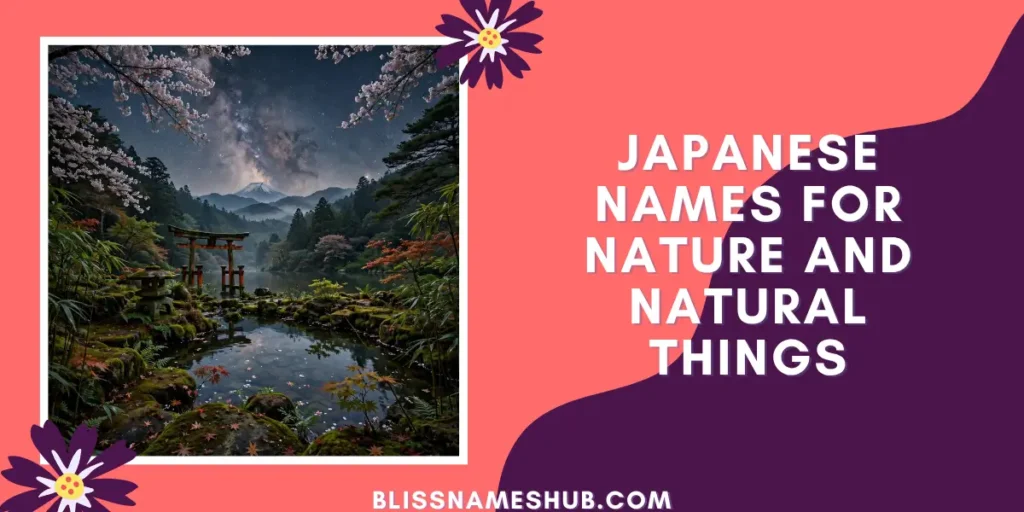
Nature has an important place in Japanese art, poetry, gardens, and seasonal traditions. These words describe trees, plants, flowers, and other natural features.
| Name | Kanji Names | Meaning | Description |
| Mori | 森 | Forest | A wooded area that suggests quiet, shade, and natural beauty. |
| Hayashi | 林 | Woods or grove | A smaller group of trees with a peaceful, sheltered feeling. |
| Ki | 木 | Tree | A simple word for a tree, often associated with growth and life. |
| Hana | 花 | Flower | A familiar word representing beauty, freshness, and blossoms. |
| Kusa | 草 | Grass | Green vegetation commonly seen in fields and gardens. |
| Take | 竹 | Bamboo | A strong, flexible plant deeply associated with Japanese culture. |
| Sasa | 笹 | Dwarf bamboo | A leafy bamboo plant often found in woodland settings. |
| Matsu | 松 | Pine tree | An evergreen tree linked with longevity and traditional gardens. |
| Sakura | 桜 | Cherry blossom | A celebrated blossom associated with spring and fleeting beauty. |
| Ume | 梅 | Plum blossom | A fragrant flower that blooms near the end of winter. |
| Kiku | 菊 | Chrysanthemum | A flower associated with autumn and Japanese tradition. |
| Tsubaki | 椿 | Camellia | A glossy-leaved flowering shrub with elegant blooms. |
| Botan | 牡丹 | Peony | A large, showy flower admired for its layered petals. |
| Yuri | 百合 | Lily | A graceful flower found in gardens and floral arrangements. |
| Sumire | 菫 | Violet | A small flower often associated with delicate beauty. |
| Ayame | 菖蒲 | Iris | A flower with distinctive petals and a graceful shape. |
| Fuji | 藤 | Wisteria | A climbing plant known for hanging clusters of flowers. |
| Kiri | 桐 | Paulownia tree | A tree with broad leaves and a place in Japanese symbolism. |
| Kashiwa | 柏 | Oak | A tree associated with sturdy leaves and traditional customs. |
| Keyaki | 欅 | Japanese zelkova | A large tree often planted along streets and in parks. |
| Sugi | 杉 | Japanese cedar | A tall evergreen commonly found in forests and temple grounds. |
| Hinoki | 檜 | Japanese cypress | A fragrant timber tree valued in traditional architecture. |
| Kuro | 黒 | Black | A color word that can describe dark natural features. |
| Shiro | 白 | White | A color associated with snow, pale stones, and white flowers. |
| Midori | 緑 | Green | The color of fresh leaves, grass, and flourishing plants. |
| Iwa | 岩 | Rock | A large, solid natural stone found in mountains and streams. |
| Ishi | 石 | Stone | A common word for a stone used in paths and gardens. |
| Suna | 砂 | Sand | Fine grains found on beaches, riverbanks, and dry ground. |
| Tsuchi | 土 | Soil or earth | The ground in which plants grow and roots spread. |
| Nendo | 粘土 | Clay | Soft earth that can be shaped into pottery and other objects. |
| Hana no Michi | 花の道 | Flower path | A descriptive phrase for a path lined with flowers. |
| Wakaba | 若葉 | Young leaves | Fresh new leaves that appear during the growing season. |
| Koke | 苔 | Moss | A small green plant that gives gardens a soft, ancient appearance. |
| Kinoko | きのこ | Mushroom | The everyday Japanese word for a mushroom. |
| Kuri | 栗 | Chestnut | An edible nut that is especially familiar in autumn foods. |
| Donguri | どんぐり | Acorn | The nut of an oak tree, often associated with woodland scenes. |
| Shiba | 芝 | Lawn grass | Grass grown as a covering in gardens and open spaces. |
| Niji | 虹 | Rainbow | A colorful arc that appears in the sky after rain. |
| Kaze | 風 | Wind | Moving air that can suggest freedom and changing weather. |
| Tsuyu | 梅雨 | Rainy season | The early-summer rainy period in much of Japan. |
| Aki | 秋 | Autumn | The season of changing leaves and cooler days. |
| Haru | 春 | Spring | The season associated with new growth and cherry blossoms. |
| Natsu | 夏 | Summer | The warm season of greenery, festivals, and long days. |
| Fuyu | 冬 | Winter | The cold season associated with snow in many regions. |
| Shizuku | 雫 | Droplet | A small drop of water resting on a leaf or flower. |
| Kaede | 楓 | Maple | A tree admired for its colorful autumn foliage. |
| Momiji | 紅葉 | Autumn leaves | A word often used for the red and golden colors of fall. |
| Wakasa | 若さ | Youth | A word for youth or freshness, suitable for a poetic theme. |
| Izumi | 泉 | Spring or fountain | A natural source of water that suggests freshness. |
| Niwa | 庭 | Garden | An outdoor space arranged for plants, stones, and quiet enjoyment. |
| Shizen | 自然 | Nature | The natural world, including plants, animals, land, and weather. |
Japanese Names for the Sky and Celestial Objects
These words relate to the sky, stars, the moon, the sun, and weather. They work well for fantasy settings, fictional places, and creative projects inspired by the heavens.
| Name | Kanji Names | Meaning | Description |
| Sora | 空 | Sky | The open space above the earth, associated with freedom. |
| Taiyou | 太陽 | Sun | The star that provides light and warmth to Earth. |
| Tsuki | 月 | Moon | The natural satellite visible in the night sky. |
| Hoshi | 星 | Star | A luminous object seen in the night sky. |
| Uchuu | 宇宙 | Universe or space | The vast expanse containing stars, planets, and galaxies. |
| Ginga | 銀河 | Galaxy | A large system of stars, gas, and cosmic dust. |
| Seiza | 星座 | Constellation | A recognizable pattern of stars in the sky. |
| Tenkuu | 天空 | Heavens or sky | A literary word for the broad expanse overhead. |
| Yoake | 夜明け | Dawn | The time when the sky begins to brighten before sunrise. |
| Akatsuki | 暁 | Daybreak | An expressive word for the early light before morning. |
| Asa | 朝 | Morning | The early part of the day, full of new possibilities. |
| Hiru | 昼 | Daytime | The bright part of the day between morning and evening. |
| Yuu | 夕 | Evening | A short word associated with the end of the day. |
| Yuugure | 夕暮れ | Dusk | The fading light around sunset. |
| Yoru | 夜 | Night | The dark period after sunset. |
| Mayonaka | 真夜中 | Midnight | The middle of the night, often used in mysterious settings. |
| Hikari | 光 | Light | Brightness that makes objects visible. |
| Kage | 影 | Shadow | A dark shape formed when an object blocks light. |
| Niji | 虹 | Rainbow | A colorful arc created by sunlight and water droplets. |
| Kumori | 曇り | Cloudiness | A weather condition in which clouds cover the sky. |
| Kumo | 雲 | Cloud | A visible mass of water droplets or ice crystals in the sky. |
| Ame | 雨 | Rain | Water falling from clouds. |
| Yuki | 雪 | Snow | Frozen precipitation that can cover the ground in winter. |
| Arashi | 嵐 | Storm | Severe weather involving strong winds and rain. |
| Kaminari | 雷 | Thunder | The sound associated with electrical activity in a storm. |
| Inazuma | 稲妻 | Lightning | A bright electrical flash across the sky. |
| Raikou | 雷光 | Lightning glow | A literary expression for the light produced by lightning. |
| Kasumi | 霞 | Haze | A light atmospheric veil that softens distant scenery. |
| Kiri | 霧 | Fog | Tiny suspended water droplets that reduce visibility near the ground. |
| Kirameki | きらめき | Sparkle | A glimmering effect like light on stars or water. |
| Nagareboshi | 流れ星 | Shooting star | A meteor that appears to streak across the night sky. |
| Amanogawa | 天の川 | Milky Way | The luminous band of stars visible across a dark sky. |
| Suisei | 彗星 | Comet | An icy celestial object that may develop a glowing tail. |
| Wakusei | 惑星 | Planet | A celestial body that orbits a star. |
| Chikyuu | 地球 | Earth | The planet on which people, animals, and plants live. |
| Kousei | 恒星 | Fixed star | A star that produces its own light and energy. |
| Eisei | 衛星 | Satellite | An object that orbits a planet or another celestial body. |
| Nichibotsu | 日没 | Sunset | The time when the sun disappears below the horizon. |
| Hinode | 日の出 | Sunrise | The moment the sun appears above the horizon. |
| Nisshoku | 日食 | Solar eclipse | An event in which the moon obscures the sun partly or fully. |
| Gesshoku | 月食 | Lunar eclipse | An event in which Earth’s shadow falls on the moon. |
| Mangetsu | 満月 | Full moon | The lunar phase in which the moon appears fully illuminated. |
| Mikazuki | 三日月 | Crescent moon | A thin curved moon visible near the beginning or end of a lunar cycle. |
| Shingetsu | 新月 | New moon | The lunar phase when the moon is not readily visible from Earth. |
| Tsukikage | 月影 | Moonlight or moon’s image | A poetic word for the moon’s light or reflection. |
| Hoshizora | 星空 | Starry sky | A night sky filled with visible stars. |
| Seiun | 星雲 | Nebula | A cloud of gas and dust in space. |
| Tenmon | 天文 | Astronomy | The study of celestial objects and phenomena. |
| Tenki | 天気 | Weather | The atmospheric conditions at a particular time and place. |
| Seiran | 青嵐 | Early-summer breeze | A literary term for a fresh, green-season wind. |
Japanese Names for Water, Rivers, Mountains, and Landscapes
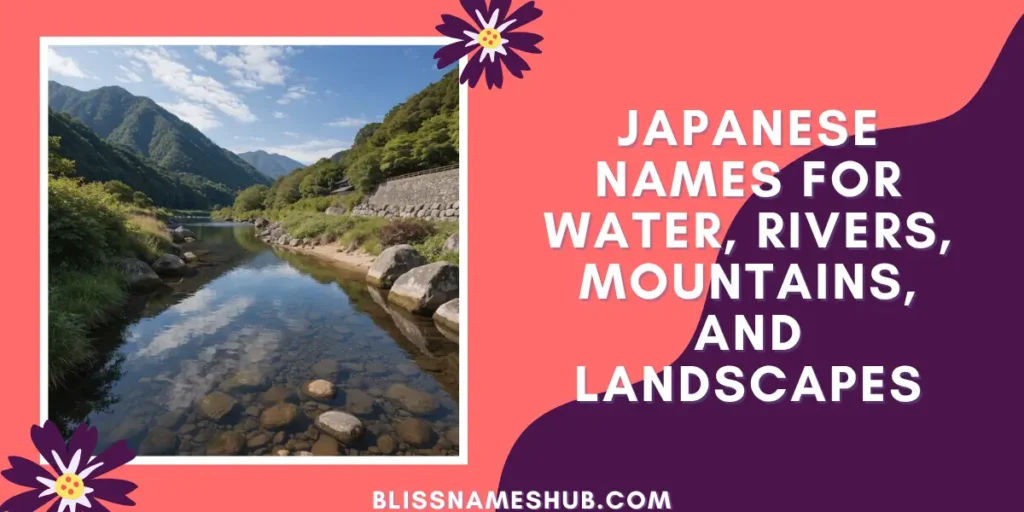
Japanese landscapes include mountain ranges, clear streams, waterfalls, coastal views, and quiet lakes. These words are especially useful when naming fictional worlds, gardens, scenic locations, or nature-themed projects.
| Name | Kanji Names | Meaning | Description |
| Yama | 山 | Mountain | A raised area of land that may have steep slopes and a high summit. |
| Kawabe | 川辺 | Riverside | Land beside a river, often associated with peaceful scenery. |
| Kawa | 川 | River | A natural stream of flowing water. |
| Mizu | 水 | Water | An essential natural resource found in rivers, lakes, and seas. |
| Umi | 海 | Sea | A large body of salt water surrounding coastal regions. |
| Minato | 港 | Harbor | A sheltered place where boats and ships can dock. |
| Misaki | 岬 | Cape | A piece of land extending outward into the sea. |
| Shima | 島 | Island | Land surrounded by water on every side. |
| Kosui | 湖水 | Lake water | Water contained in a lake or inland body of water. |
| Mizuumi | 湖 | Lake | A large inland body of standing water. |
| Taki | 滝 | Waterfall | Water that drops from a height over a rock face or cliff. |
| Shizuku | 雫 | Droplet | A small amount of liquid hanging from a surface or falling through the air. |
| Nagare | 流れ | Flow | The movement of water through a stream or river. |
| Seiryu | 清流 | Clear stream | A stream known for its clean, clear water. |
| Keiryu | 渓流 | Mountain stream | A flowing stream that runs through a valley or mountain area. |
| Tanima | 谷間 | Valley | A low area of land between hills or mountains. |
| Tani | 谷 | Valley | A stretch of low land often shaped by water erosion. |
| Kyoukoku | 峡谷 | Gorge | A deep, narrow valley with steep sides. |
| Takaiwa | 高岩 | High rock | A descriptive combination suitable for a rocky fictional landmark. |
| Iwa | 岩 | Rock | A large mass of stone that forms part of a landscape. |
| Ganseki | 岩石 | Rock or stone | A general term for solid natural material forming the earth’s crust. |
| Sawa | 沢 | Mountain stream or marsh | A word used in place names associated with wet or water-rich land. |
| Numa | 沼 | Marsh or swamp | A wetland area with standing water and water-loving vegetation. |
| Shicchi | 湿地 | Wetland | Land that remains wet for all or part of the year. |
| Sabaku | 砂漠 | Desert | A dry region that receives very little precipitation. |
| Sunahama | 砂浜 | Sandy beach | A shore covered with sand rather than mainly rocks. |
| Hamabe | 浜辺 | Beach | The strip of land along the edge of a body of water. |
| Nagisa | 渚 | Shore | The area where land meets the water. |
| Kaigan | 海岸 | Coast | Land that borders a sea or ocean. |
| Enkai | 沿海 | Coastal area | A region situated along the sea. |
| Oki | 沖 | Offshore waters | Water located away from the shore. |
| Enko | 円弧 | Arc | A curved line or section of a circle, suitable for a shaped landmark. |
| Shio | 潮 | Tide | The regular rise and fall of sea levels. |
| Shiomizu | 潮水 | Seawater | Water from the sea, especially in relation to tides. |
| Shiosai | 潮騒 | Sound of waves | The continuous sound of moving seawater along a shore. |
| Nami | 波 | Wave | A moving ridge on the surface of water. |
| Uzu | 渦 | Whirlpool | Water that turns rapidly around a central point. |
| Funauta | 舟歌 | Boat song | A traditional-style song associated with boats and waterways. |
| Kiriishi | 切石 | Cut stone | Stone shaped for use in construction or landscaping. |
| Touge | 峠 | Mountain pass | A route crossing a mountain ridge between higher slopes. |
| Saka | 坂 | Slope | A road or path that rises or falls over a hill. |
| Oka | 丘 | Hill | A raised area of land smaller than a mountain. |
| Kogen | 高原 | Plateau or highland | A broad elevated area of land. |
| Heiya | 平野 | Plain | A large area of relatively flat land. |
| Daichi | 大地 | Great earth | An expressive word for the broad surface of the land. |
| Genya | 原野 | Open wilderness | A wide, undeveloped stretch of land. |
| Kusahara | 草原 | Grassland | Open land covered mainly with grasses. |
| Takahara | 高原 | Highland | An elevated area with broad open terrain. |
| Hakuchi | 白地 | Blank or unmarked ground | A word more often used for an unmarked area than a natural landmark. |
| Fuchi | 淵 | Deep pool | A deep section of a river or stream. |
| Suigen | 水源 | Water source | The place where a river or water supply originates. |
Japanese Names for Buildings and Places
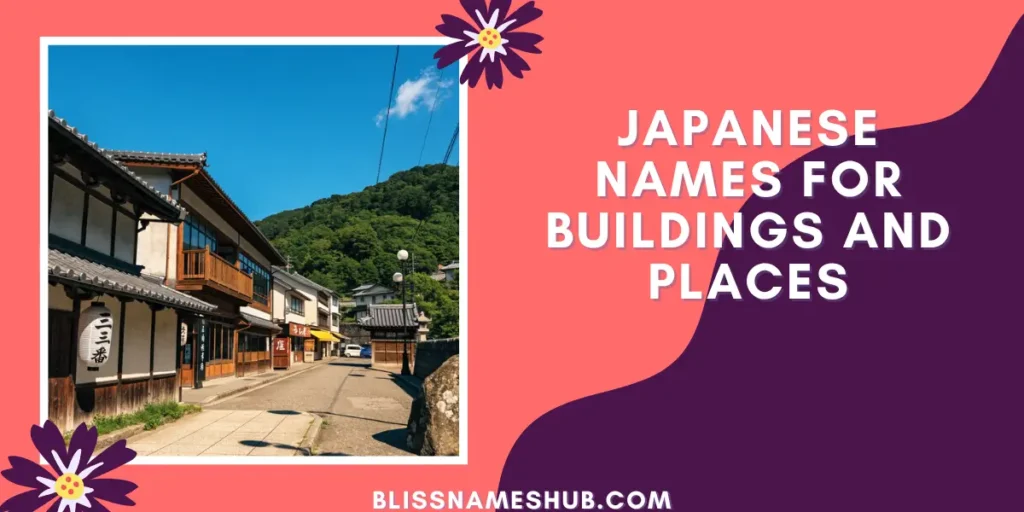
From peaceful shrines to busy stations, Japanese place words can help describe settings in stories, travel guides, games, and cultural projects. Some entries are general place names rather than proper names of individual locations.
| Name | Kanji Names | Meaning | Description |
| Machi | 町 | Town | A settlement with homes, shops, and local streets. |
| Mura | 村 | Village | A small community, often associated with a quieter way of life. |
| Toshi | 都市 | City | A large, developed settlement with many residents and services. |
| Kuni | 国 | Country | A nation or land with its own identity and boundaries. |
| Kyoudai | 郷 | Hometown or region | A character used in words and names associated with a home region. |
| Eki | 駅 | Station | A place where passengers board or leave trains. |
| Kuukou | 空港 | Airport | A facility for arriving and departing aircraft. |
| Minato | 港 | Port | A place where ships load, unload, and take shelter. |
| Michi | 道 | Road or path | A route connecting one place to another. |
| Oodoori | 大通り | Main street | A broad street that carries traffic through a town or city. |
| Shingou | 信号 | Traffic signal | A signal used to control movement at road intersections. |
| Hashi | 橋 | Bridge | A structure that allows people and vehicles to cross an obstacle. |
| Tonneru | トンネル | Tunnel | An underground or enclosed passage through land or rock. |
| Kouen | 公園 | Park | A public outdoor space for walking, playing, and relaxing. |
| Teien | 庭園 | Garden | A planned outdoor area featuring plants, paths, and design elements. |
| Jinja | 神社 | Shinto shrine | A place of worship associated with Shinto traditions. |
| Tera | 寺 | Buddhist temple | A religious place associated with Buddhist practice. |
| Daibutsuden | 大仏殿 | Great Buddha hall | A hall built to house a large statue of Buddha. |
| Torii | 鳥居 | Shrine gate | A traditional gate marking the entrance to a Shinto sacred space. |
| Shinden | 神殿 | Sanctuary or shrine hall | A building or hall used for religious purposes. |
| Byouin | 病院 | Hospital | A medical facility that provides treatment and care. |
| Gakkou | 学校 | School | A place where students receive education. |
| Daigaku | 大学 | University | An institution for advanced education and research. |
| Toshokan | 図書館 | Library | A place where people can read, borrow, or consult books. |
| Hakubutsukan | 博物館 | Museum | A place that preserves and displays historical or cultural objects. |
| Bijutsukan | 美術館 | Art museum | A gallery or museum dedicated mainly to visual art. |
| Gekijou | 劇場 | Theater | A venue where plays and performances take place. |
| Eigakan | 映画館 | Cinema | A place where films are shown to an audience. |
| Kaikan | 会館 | Public hall | A building used for gatherings, events, and community activities. |
| Shiyakusho | 市役所 | City hall | A municipal office responsible for local administration. |
| Kenchousha | 県庁舎 | Prefectural government building | A building that houses a prefecture’s administrative offices. |
| Honsha | 本社 | Headquarters | The main office of an organization or company. |
| Kaisha | 会社 | Company | A business organization or the workplace associated with it. |
| Shijou | 市場 | Market | A place where goods are bought and sold. |
| Shotengai | 商店街 | Shopping street | A street or district lined with shops and small businesses. |
| Depaato | デパート | Department store | A large retail store with different product departments. |
| Mise | 店 | Shop | A general word for a place that sells goods or services. |
| Resutoran | レストラン | Restaurant | An establishment where meals are prepared and served. |
| Kissaten | 喫茶店 | Coffee shop | A traditional-style Japanese café serving drinks and light meals. |
| Ryokan | 旅館 | Japanese inn | Traditional accommodation often featuring tatami rooms and Japanese hospitality. |
| Hoteru | ホテル | Hotel | A place providing paid accommodation for travelers. |
| Onsen | 温泉 | Hot spring | Naturally heated mineral water used for bathing and relaxation. |
| Yuubinkyoku | 郵便局 | Post office | A place for mailing letters and parcels and handling postal services. |
| Ginkou | 銀行 | Bank | An institution that holds money and provides financial services. |
| Keisatsusho | 警察署 | Police station | A facility used by police for public safety and law enforcement. |
| Shoubousho | 消防署 | Fire station | A base for firefighters and emergency response vehicles. |
| Taikukan | 体育館 | Gymnasium | An indoor facility used for sports and physical activities. |
| Undoujou | 運動場 | Sports ground | An open area designed for exercise and athletic activities. |
| Hakubutsukan | 博物館 | Museum | A place where collections are preserved and presented to visitors. |
| Shiro | 城 | Castle | A fortified structure historically used by rulers and military leaders. |
| Mon | 門 | Gate | An entrance marking the boundary of a building or enclosed area. |
Japanese Names for Rooms and Household Places
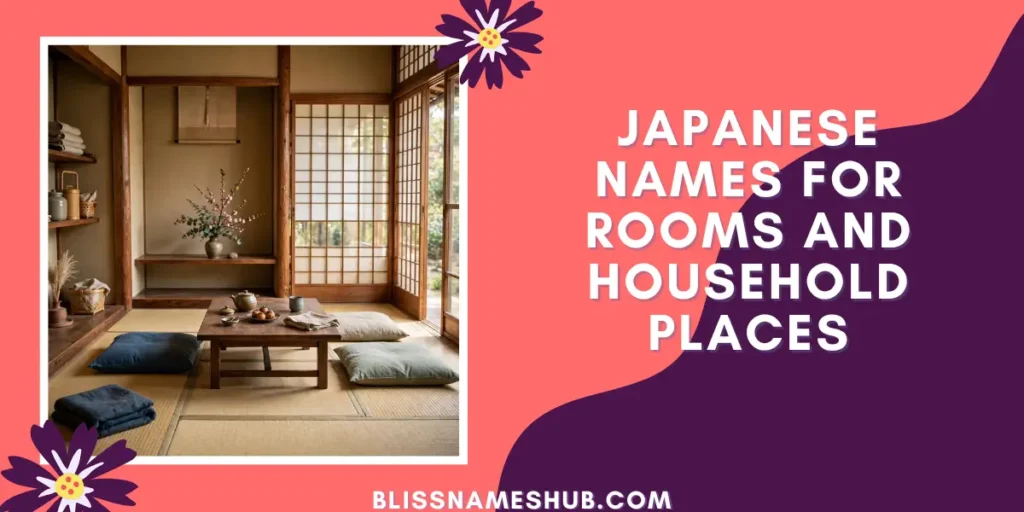
These Japanese words describe the rooms and spaces found in homes and traditional buildings. They can also help when creating settings for stories, interior designs, or themed projects.
| Name | Kanji Names | Meaning | Description |
| Ie | 家 | House or home | A place where people live and carry out daily activities. |
| Uchi | 家 | Home | A familiar way to refer to one’s home or household. |
| Heya | 部屋 | Room | An enclosed space within a home or building. |
| Genkan | 玄関 | Entryway | The entrance area where people remove outdoor shoes in many Japanese homes. |
| Ima | 居間 | Living room | A shared space for relaxing and spending time with family. |
| Shokudou | 食堂 | Dining room | A place where people sit down to eat meals. |
| Daidokoro | 台所 | Kitchen | The area where food is prepared and cooked. |
| Ofuro | お風呂 | Bath | A bath or bathing area used for washing and relaxation. |
| Yokushitsu | 浴室 | Bathroom | A room designed for bathing. |
| Toire | トイレ | Toilet | The room or facility containing a toilet. |
| Washitsu | 和室 | Japanese-style room | A room traditionally arranged with tatami flooring. |
| Youshitsu | 洋室 | Western-style room | A room arranged in a Western style, often with a standard floor. |
| Shitsunai | 室内 | Indoors | The interior space within a building. |
| Niwa | 庭 | Garden | An outdoor space attached to a home or building. |
| Engawa | 縁側 | Veranda | A narrow transitional space along the edge of a traditional Japanese house. |
| Rouka | 廊下 | Hallway | A passage connecting rooms in a building. |
| Kaidan | 階段 | Stairs | Steps used to move between different levels. |
| Genkanmae | 玄関前 | In front of the entrance | The area immediately outside a building’s entryway. |
| Nando | 納戸 | Storage room | A small room used for storing household items. |
| Kura | 蔵 | Storehouse | A traditional storage building designed to protect valuable goods. |
| Zashiki | 座敷 | Tatami room | A Japanese-style room used for sitting, receiving guests, or formal occasions. |
| Tokonoma | 床の間 | Decorative alcove | A recessed area in a traditional room for displaying art or flowers. |
| Oshiire | 押し入れ | Closet | A built-in storage space often used for bedding and household items. |
| Tenjou | 天井 | Ceiling | The upper interior surface of a room. |
| Yuka | 床 | Floor | The surface on which people walk and furniture rests. |
| Kabe | 壁 | Wall | A vertical structure separating rooms or enclosing a space. |
| Mado | 窓 | Window | An opening that provides light, air, or a view. |
| Tobira | 扉 | Door | A movable panel used to enter or close off a space. |
| Fusuma | 襖 | Sliding partition | A traditional opaque sliding panel used between rooms. |
| Shouji | 障子 | Paper sliding screen | A light screen traditionally made with a wooden frame and translucent paper. |
| Amado | 雨戸 | Storm shutter | An exterior shutter used to protect windows from weather. |
| Ro | 炉 | Hearth | A traditional sunken hearth used for heating or preparing tea. |
| Irori | 囲炉裏 | Sunken hearth | A traditional indoor hearth often used for warmth and cooking. |
| Doma | 土間 | Earthen-floored area | A practical space near the entrance of some traditional homes. |
| Chashitsu | 茶室 | Tea room | A room designed for the Japanese tea ceremony. |
| Zakkashitsu | 雑貨室 | Miscellaneous storage room | A descriptive compound for a space holding assorted household goods. |
| Shosai | 書斎 | Study | A room used for reading, writing, or working. |
| Benkyoubeya | 勉強部屋 | Study room | A room arranged for learning and homework. |
| Kodomobeya | 子供部屋 | Children’s room | A bedroom or personal space for children. |
| Shinshitsu | 寝室 | Bedroom | A room mainly used for sleeping. |
| Guest Room | 客室 | Guest room | A room prepared for visitors to stay or relax. |
| Senmenjo | 洗面所 | Washroom | An area with a basin for washing hands and face. |
| Sentaku-ba | 洗濯場 | Laundry area | A space where clothes are washed and prepared for drying. |
| Hoshi-ba | 干し場 | Drying area | A place where laundry or other items are left to dry. |
| Reizouko-mae | 冷蔵庫前 | In front of the refrigerator | A descriptive household location rather than a fixed room name. |
| Uraniwa | 裏庭 | Backyard | The garden or open space behind a house. |
| Omoteniwa | 表庭 | Front garden | The garden area toward the front of a property. |
| Monzen | 門前 | In front of a gate | The area just outside the entrance gate of a property or temple. |
| Chushajo | 駐車場 | Parking lot | A designated area for parking cars and other vehicles. |
| Souko | 倉庫 | Warehouse | A building used to store goods, supplies, or equipment. |
Japanese Names for Everyday Objects and Useful Things
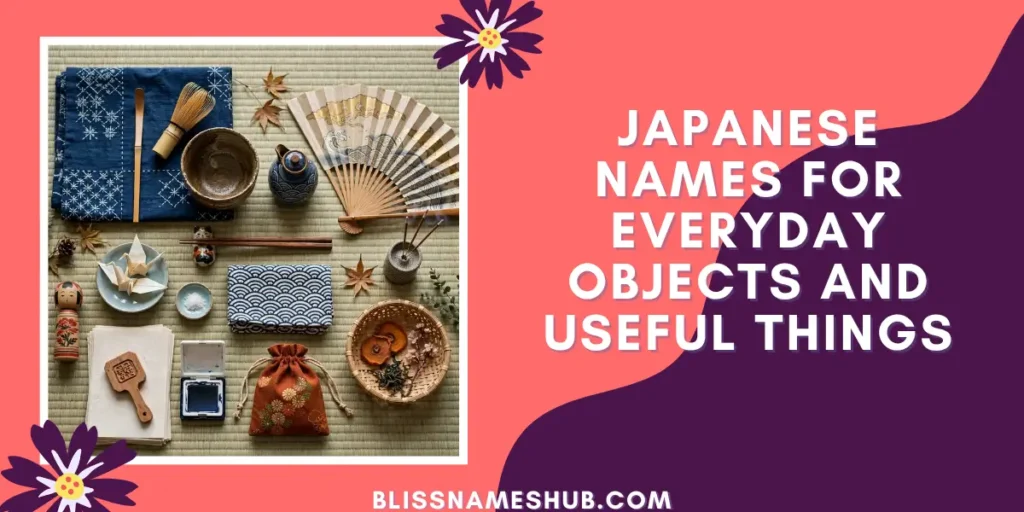
Everyday Japanese vocabulary includes many short, memorable words for objects used at home, at school, and while traveling. These entries are useful for naming fictional objects, creative collections, and themed projects.
| Name | Kanji Names | Meaning | Description |
| Hon | 本 | Book | A collection of written or printed pages used for reading. |
| Kami | 紙 | Paper | A thin material used for writing, drawing, and wrapping. |
| Enpitsu | 鉛筆 | Pencil | A writing tool that leaves marks using graphite. |
| Pen | ペン | Pen | A tool that uses ink for writing or drawing. |
| Fude | 筆 | Brush | A brush used for painting, calligraphy, or applying ink. |
| Suzuri | 硯 | Inkstone | A traditional stone surface used to prepare ink for calligraphy. |
| Sumi | 墨 | Ink | Black ink traditionally used in Japanese brush writing. |
| Kami-kazari | 紙飾り | Paper decoration | A decorative object made from folded or shaped paper. |
| Orizuru | 折り鶴 | Folded paper crane | An origami crane often associated with hope and thoughtful wishes. |
| Sensu | 扇子 | Folding fan | A portable fan that folds into a compact shape. |
| Uchiwa | 団扇 | Flat fan | A rigid fan traditionally used to create a cooling breeze. |
| Kasa | 傘 | Umbrella | An object used to protect people from rain or strong sunlight. |
| Kutsu | 靴 | Shoes | Footwear worn outside or for particular activities. |
| Zori | 草履 | Traditional sandals | Flat Japanese-style sandals worn with suitable clothing. |
| Geta | 下駄 | Wooden clogs | Traditional raised footwear with a wooden base. |
| Obi | 帯 | Sash | A wide belt worn with a kimono or other traditional garments. |
| Kimono | 着物 | Traditional Japanese garment | A robe-like garment recognized for its distinctive shape and patterns. |
| Haori | 羽織 | Short jacket | A traditional outer garment worn over a kimono. |
| Himo | 紐 | Cord or string | A flexible length of material used for tying and fastening. |
| Ito | 糸 | Thread | A thin strand used in sewing, weaving, and crafts. |
| Hari | 針 | Needle | A slender tool used for sewing or other precise work. |
| Hasami | はさみ | Scissors | A cutting tool with two blades joined at a pivot. |
| Nuno | 布 | Cloth | Fabric used for clothing, decoration, and household purposes. |
| Furoshiki | 風呂敷 | Wrapping cloth | A square cloth traditionally used to wrap and carry objects. |
| Kaban | 鞄 | Bag | A container used to carry personal belongings. |
| Saifu | 財布 | Wallet | A small case for carrying money and cards. |
| Kagami | 鏡 | Mirror | A reflective surface used for viewing one’s appearance. |
| Tokei | 時計 | Clock or watch | A device that shows or measures time. |
| Megane | 眼鏡 | Glasses | Eyewear used to correct vision or protect the eyes. |
| Rousoku | 蝋燭 | Candle | A wax object with a wick that produces light when burning. |
| Akari | 明かり | Light | Illumination provided by a lamp, flame, or other source. |
| Chouchin | 提灯 | Paper lantern | A traditional lantern often seen at festivals and entrances. |
| Andon | 行灯 | Traditional lamp | A traditional Japanese lamp that commonly uses a paper-covered frame. |
| Kouro | 香炉 | Incense burner | A vessel designed to hold burning incense. |
| Senkou | 線香 | Incense stick | A slender stick burned to release fragrant smoke. |
| Hanaire | 花入れ | Flower vase | A container used to hold flowers in an arrangement. |
| Tsubo | 壺 | Jar or pot | A rounded vessel used for storage or decoration. |
| Chawan | 茶碗 | Tea bowl | A bowl used for drinking tea or serving rice. |
| Yunomi | 湯呑み | Tea cup | A handleless cup commonly used for everyday Japanese tea. |
| Hashi | 箸 | Chopsticks | Two narrow sticks used together for eating food. |
| Sara | 皿 | Plate | A flat dish used to serve food. |
| Wan | 椀 | Bowl | A bowl commonly used for soup, rice, or other dishes. |
| Nabe | 鍋 | Cooking pot | A pot used for cooking, including Japanese hot-pot dishes. |
| Kama | 釜 | Cauldron or cooking pot | A traditional vessel used for cooking or heating. |
| Shamoji | しゃもじ | Rice paddle | A broad utensil used to serve or mix cooked rice. |
| Oke | 桶 | Wooden tub or bucket | A container traditionally made from joined wooden staves. |
| Tansu | 箪笥 | Chest of drawers | A traditional cabinet used to store clothing and personal belongings. |
| Tansu-kazari | 箪笥飾り | Chest decoration | A descriptive phrase for a decorative object placed on a storage chest. |
| Kagi | 鍵 | Key | A small object used to lock or unlock a compatible lock. |
| Fuda | 札 | Tag or card | A small card or marker used for identification or labeling. |
Japanese Names for Food, Drinks, and Kitchen Items
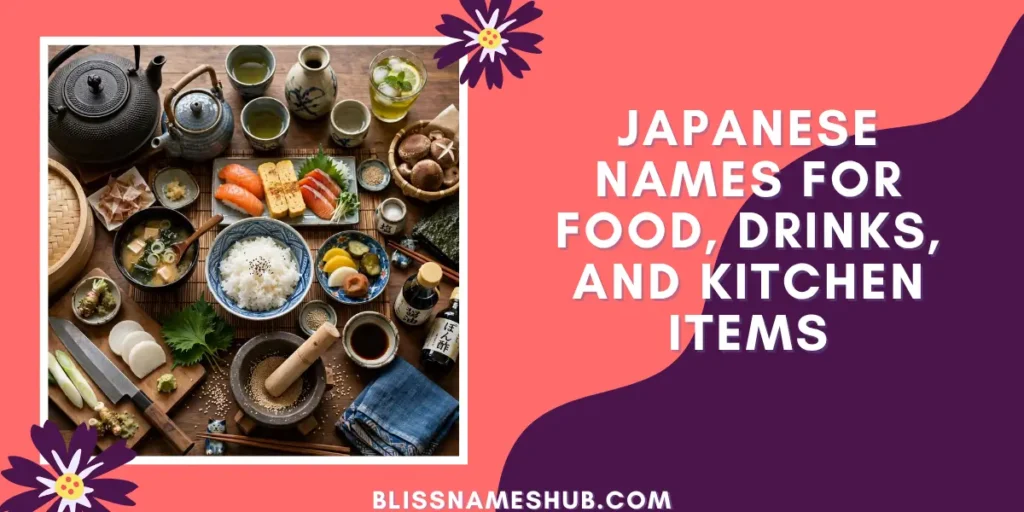
Japanese food vocabulary includes ingredients, traditional dishes, sweets, and drinks. These words can inspire names for fictional cafés, food-themed games, cooking projects, or collections celebrating Japanese cuisine.
| Name | Kanji Names | Meaning | Description |
| Gohan | ご飯 | Cooked rice or meal | A common word for cooked rice and, in context, a meal. |
| Kome | 米 | Rice grain | The uncooked grain that forms the basis of many Japanese meals. |
| Mochi | 餅 | Rice cake | A soft, chewy cake made from pounded glutinous rice. |
| Dango | 団子 | Rice dumpling | A small, rounded dumpling often served on a skewer. |
| Daifuku | 大福 | Filled rice cake | A soft rice cake commonly filled with sweet bean paste. |
| Taiyaki | たい焼き | Fish-shaped cake | A fish-shaped cake usually filled with sweet red bean paste or other fillings. |
| Dorayaki | どら焼き | Filled pancake sweet | Two small pancakes traditionally joined with sweet bean paste. |
| Manju | 饅頭 | Steamed bun or sweet | A soft bun commonly filled with sweet bean paste. |
| Yokan | 羊羹 | Firm sweet bean jelly | A dense confection often made with red bean paste and agar. |
| Anko | 餡子 | Sweet bean paste | A sweet filling used in many traditional Japanese desserts. |
| Wagashi | 和菓子 | Japanese sweets | Traditional confections often shaped to reflect seasons and nature. |
| Senbei | 煎餅 | Rice cracker | A crunchy snack made mainly from rice. |
| Okashi | お菓子 | Sweets or snacks | A general word for confectionery and sweet treats. |
| Ame | 飴 | Candy | A general term for hard candy and similar sweets. |
| Konpeitou | 金平糖 | Sugar candy | A small, colorful sugar candy with a distinctive spiky shape. |
| Matcha | 抹茶 | Powdered green tea | Finely ground green tea used for drinking and cooking. |
| Sencha | 煎茶 | Green tea | A popular Japanese tea made by steeping processed tea leaves. |
| Hojicha | ほうじ茶 | Roasted green tea | A roasted tea known for its warm aroma and mellow flavor. |
| Genmaicha | 玄米茶 | Brown rice tea | Green tea blended with roasted rice for a nutty taste. |
| Sakurayu | 桜湯 | Cherry blossom tea | A warm drink made with preserved cherry blossoms and hot water. |
| Mizu | 水 | Water | A basic drink and an essential ingredient in cooking. |
| Ocha | お茶 | Tea | A common word for tea, particularly familiar in everyday conversation. |
| Gyunyu | 牛乳 | Milk | Milk used in drinks, cooking, and desserts. |
| Amazake | 甘酒 | Sweet rice drink | A traditional sweet drink made from fermented rice or rice koji. |
| Miso | 味噌 | Fermented soybean paste | A savory ingredient used in soup, marinades, and sauces. |
| Shoyu | 醤油 | Soy sauce | A fermented sauce used to season many Japanese dishes. |
| Shio | 塩 | Salt | A common seasoning used to enhance the flavor of food. |
| Su | 酢 | Vinegar | A sour liquid used in dressings, pickling, and seasoning. |
| Mirin | みりん | Sweet rice seasoning | A sweet cooking seasoning commonly used in Japanese dishes. |
| Dashi | 出汁 | Soup stock | A flavorful broth that forms the base of many Japanese soups. |
| Tofu | 豆腐 | Soybean curd | A soft food made from coagulated soy milk. |
| Natto | 納豆 | Fermented soybeans | A traditional food known for its sticky texture and distinctive aroma. |
| Umeboshi | 梅干し | Pickled plum | A salty, sour preserved plum often served with rice. |
| Tsukemono | 漬物 | Pickled vegetables | Vegetables preserved with salt, vinegar, or other seasonings. |
| Nori | 海苔 | Edible seaweed | Thin sheets of seaweed used in sushi and rice dishes. |
| Wakame | わかめ | Edible seaweed | A sea vegetable commonly added to soups and salads. |
| Soba | 蕎麦 | Buckwheat noodles | Noodles made primarily from buckwheat flour. |
| Udon | うどん | Thick wheat noodles | Soft, thick noodles served hot in broth or chilled with dipping sauce. |
| Ramen | ラーメン | Noodle soup | A noodle dish commonly served with broth and various toppings. |
| Sushi | 寿司 | Vinegared rice dish | A Japanese dish built around seasoned rice and varied toppings or fillings. |
| Onigiri | おにぎり | Rice ball | A portable serving of rice often shaped by hand and filled or wrapped. |
| Tempura | 天ぷら | Lightly battered fried food | Seafood or vegetables coated in batter and fried. |
| Yakitori | 焼き鳥 | Grilled chicken skewers | Small pieces of chicken grilled on skewers, often with seasoning. |
| Takoyaki | たこ焼き | Octopus balls | Round batter cakes commonly filled with pieces of octopus. |
| Okonomiyaki | お好み焼き | Savory pancake | A cooked batter dish mixed with ingredients such as cabbage. |
| Kare | カレー | Curry | A seasoned sauce or curry dish commonly served with rice. |
| Bento | 弁当 | Packed meal | A meal arranged in a portable box with separate portions. |
| Tamagoyaki | 卵焼き | Rolled omelet | A Japanese-style omelet cooked in layers and rolled together. |
| Yuzu | 柚子 | Japanese citrus fruit | A fragrant citrus fruit used in sauces, drinks, and seasonal dishes. |
| Ichigo | 苺 | Strawberry | A sweet red fruit enjoyed fresh and in desserts. |
Japanese Names for Travel, Culture, and Special Places

These words relate to journeys, traditional architecture, public spaces, and cultural landmarks. Some are common nouns, while others describe features that visitors may encounter in Japan.
| Name | Kanji Names | Meaning | Description |
| Tabi | 旅 | Journey | A trip from one place to another, whether short or long. |
| Ryokou | 旅行 | Travel | The act of visiting places away from one’s usual surroundings. |
| Michishirube | 道しるべ | Road sign or guidepost | A marker that helps travelers follow a route. |
| Chizu | 地図 | Map | A visual representation of roads, regions, and geographical features. |
| Annai | 案内 | Guidance | Information or directions that help someone find a place. |
| Kankou | 観光 | Sightseeing | Visiting places for their scenery, history, or cultural interest. |
| Meisho | 名所 | Famous place | A location recognized for its beauty, history, or popularity. |
| Keishouchi | 景勝地 | Scenic spot | A place admired for its attractive landscape or views. |
| Yuuenchi | 遊園地 | Amusement park | A recreational destination with rides, games, and attractions. |
| Doubutsuen | 動物園 | Zoo | A place where visitors can observe animals in managed habitats. |
| Suizokukan | 水族館 | Aquarium | A facility displaying aquatic animals and underwater environments. |
| Shokubutsuen | 植物園 | Botanical garden | A garden dedicated to cultivating and displaying plants. |
| Onsenchi | 温泉地 | Hot-spring area | A destination known for its natural hot springs and bathing facilities. |
| Toudaiji | 東大寺 | Great Eastern Temple | A historic Buddhist temple complex in Nara. |
| Kinkakuji | 金閣寺 | Temple of the Golden Pavilion | A famous Kyoto temple known for its golden exterior. |
| Ginkakuji | 銀閣寺 | Temple of the Silver Pavilion | A Kyoto temple associated with traditional architecture and gardens. |
| Kiyomizudera | 清水寺 | Pure Water Temple | A historic Kyoto temple famous for its wooden terrace. |
| Fushimi Inari Taisha | 伏見稲荷大社 | Inari grand shrine | A Kyoto shrine known for its long paths of red torii gates. |
| Meiji Jingu | 明治神宮 | Meiji Shrine | A Tokyo Shinto shrine surrounded by a large wooded area. |
| Itsukushima Jinja | 厳島神社 | Itsukushima Shrine | A shrine on Miyajima known for its scenic waterfront setting. |
| Himeji-jou | 姫路城 | Himeji Castle | A historic Japanese castle recognized for its white appearance. |
| Matsumoto-jou | 松本城 | Matsumoto Castle | A historic castle known for its dark exterior and mountain backdrop. |
| Kumamoto-jou | 熊本城 | Kumamoto Castle | A major castle associated with the history of Kumamoto. |
| Shuri-jou | 首里城 | Shuri Castle | A historic royal site associated with the Ryukyu Kingdom in Okinawa. |
| Kenrokuen | 兼六園 | Kenrokuen Garden | A celebrated garden in Kanazawa known for its seasonal scenery. |
| Korakuen | 後楽園 | Korakuen Garden | A historic landscape garden in Okayama. |
| Kairakuen | 偕楽園 | Kairakuen Garden | A famous garden in Mito, especially associated with plum blossoms. |
| Arashiyama | 嵐山 | Storm Mountain | A Kyoto district known for its bamboo grove and scenic surroundings. |
| Takeshita-dori | 竹下通り | Takeshita Street | A popular Tokyo shopping street in Harajuku. |
| Nakamise-dori | 仲見世通り | Nakamise shopping street | A traditional shopping approach near Sensō-ji in Asakusa. |
| Omotesando | 表参道 | Main approach | A Tokyo avenue known for architecture, shopping, and cafés. |
| Shibuya | 渋谷 | Shibuya | A Tokyo district famous for its busy crossing and urban atmosphere. |
| Shinjuku | 新宿 | Shinjuku | A major Tokyo district with transport links, shops, and entertainment. |
| Akihabara | 秋葉原 | Akihabara | A Tokyo district known for electronics, gaming, and popular culture. |
| Asakusa | 浅草 | Asakusa | A Tokyo area recognized for its traditional streets and Sensō-ji Temple. |
| Ginza | 銀座 | Ginza | A Tokyo shopping district known for department stores and fine dining. |
| Ueno | 上野 | Ueno | A Tokyo district with museums, parks, and cultural attractions. |
| Odaiba | お台場 | Odaiba | A waterfront district in Tokyo with shopping and entertainment venues. |
| Yokohama | 横浜 | Yokohama | A major port city south of Tokyo with a distinctive waterfront. |
| Kyoto | 京都 | Kyoto | A historic city celebrated for temples, shrines, and traditional culture. |
| Nara | 奈良 | Nara | A historic city known for ancient temples and freely roaming deer in its park. |
| Osaka | 大阪 | Osaka | A major city known for food, commerce, and lively entertainment districts. |
| Kobe | 神戸 | Kobe | A port city known for its waterfront, hills, and international influences. |
| Sapporo | 札幌 | Sapporo | Hokkaido’s largest city, famous for winter scenery and its snow festival. |
| Hakone | 箱根 | Hakone | A scenic area known for hot springs, mountains, and views of Mount Fuji. |
| Nikko | 日光 | Nikko | A destination with ornate shrines, forested landscapes, and waterfalls. |
| Kamakura | 鎌倉 | Kamakura | A coastal city with historic temples and a famous Great Buddha statue. |
| Shirakawa-go | 白川郷 | Shirakawa village | A historic mountain settlement known for steep thatched roofs. |
| Mount Fuji | 富士山 | Mount Fuji | Japan’s iconic mountain, admired for its symmetrical volcanic shape. |
| Hiroshima Peace Memorial Park | 広島平和記念公園 | Hiroshima Peace Memorial Park | A memorial park dedicated to remembrance and peace. |
Using Japanese Names for Things & Places Creatively
Japanese Names for Things & Places can add cultural detail to a story, a digital project, a themed collection, or a fictional map. For a peaceful setting, words such as Mori, Izumi, and Hoshizora evoke forests, springs, and starry skies.
For an urban or traditional setting, words such as Machi, Torii, and Shiro refer to towns, shrine gates, and castles. Food-related terms such as Mochi and Matcha may suit café names or playful creative projects.
Before using a Japanese word commercially or as a permanent brand name, check its pronunciation, context, spelling, and any existing trademark or cultural associations.
Frequently Asked Questions
Q1: What are Japanese Names for Things & Places?
Ans: Japanese Names for Things & Places are Japanese words used for natural features, everyday objects, buildings, food, and locations. Examples include Sora for sky, Mori for forest, and Machi for town.
Q2: What is a beautiful Japanese word for a place?
Ans: Izumi (泉), meaning spring or fountain, is a lovely choice for a peaceful place. Hoshizora (星空), meaning starry sky, is another expressive option for a scenic or fictional setting.
Q3: What is the Japanese word for nature?
Ans: The Japanese word for nature is Shizen (自然). It refers to the natural world, including plants, animals, landscapes, and weather.
Q4: What are some Japanese words for places in nature?
Ans: Some common examples are Yama (山), meaning mountain; Kawa (川), meaning river; Umi (海), meaning sea; Mizuumi (湖), meaning lake; and Mori (森), meaning forest.
Q5: Can Japanese words for objects be used as creative names?
Ans: Yes. Words such as Akari (明かり), meaning light, and Sensu (扇子), meaning folding fan, may inspire creative names for fictional items, projects, or themed collections. Their suitability depends on the intended context.
Q6: Do all Japanese words have kanji?
Ans: No. Some Japanese words are normally written in hiragana or katakana, while others have standard kanji forms. The appropriate writing depends on the word and how it is used.
Q7: How can I choose an appropriate Japanese name for a fictional place?
Ans: Start with the setting you want to represent. Choose a word associated with its landscape, atmosphere, or purpose, then verify its pronunciation and meaning. For a forest setting, Mori may fit; for a mountain setting, Yama may be suitable.
Q8: Are Japanese Names for Things & Places suitable for businesses and usernames?
Ans: They can be, especially when a word is easy to pronounce and fits the identity you want to create. Check the word’s cultural meaning, existing uses, domain availability, and relevant trademark rules before using it commercially.